Governing a Distributed Workforce: How Enterprise Leaders Can Drive Accountability Without Defaulting to Surveillance
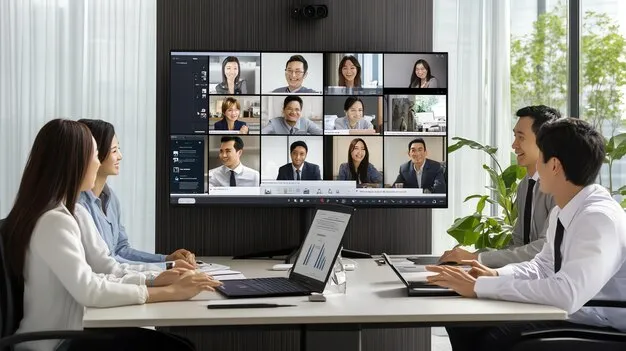
Photo: corporate team video conference remote work professional meeting, via img.freepik.com
A Governance Problem Disguised as a Management Problem
Four years after remote work became a defining feature of the American corporate landscape, many enterprise leaders are still searching for the right framework. The instinct to monitor — to verify that distributed employees are present, engaged, and productive — is understandable from a governance standpoint. Organizations carry real fiduciary and compliance obligations, and the physical office long served as a crude but functional proxy for accountability.
The problem is that the tools most commonly deployed in response to that instinct — keystroke logging, screenshot capture, continuous video monitoring — are both operationally counterproductive and legally precarious. Several US states have enacted or are actively considering legislation governing employer surveillance of remote workers. Beyond the legal exposure, the evidence on surveillance-based management is consistent: it damages trust, reduces intrinsic motivation, and accelerates voluntary attrition among precisely the high-performing employees organizations can least afford to lose.
This is not an argument against accountability. Accountability in distributed work environments is not only achievable — when structured correctly, it produces cleaner performance data than the presence-based proxies that characterized traditional office oversight. The distinction that matters is between monitoring activity and measuring outcomes.
Why Presence-Based Accountability Fails at Scale
The traditional office model conflated physical attendance with productive contribution. An employee seated at a desk for eight hours was presumed to be working. An employee who departed at 4:45 PM raised eyebrows. These heuristics were always imprecise, but they were socially reinforced and administratively convenient.
Distributed work stripped away the heuristic without replacing it with anything more rigorous, and many organizations responded by attempting to recreate the visual confirmation of presence through digital means. The result has been a proliferation of monitoring software that generates enormous volumes of activity data — login times, application usage, mouse movement — while providing almost no insight into actual business output.
For enterprise compliance and risk management purposes, this approach creates additional complications. Activity data collected through surveillance tools may be discoverable in employment disputes. Inconsistent application of monitoring across employee populations can generate discrimination exposure. And in regulated industries, the data governance requirements associated with retaining and protecting employee monitoring records add operational overhead that rarely appears in the initial cost-benefit analysis of deploying such tools.
A Results-Oriented Governance Framework
The alternative is not a trust-based honor system. It is a structured performance architecture built around defined outputs, clear measurement criteria, and regular cadences of formal review. Several US enterprises that navigated the transition from office-centric to distributed work successfully did so by implementing frameworks with the following core components.
Define Deliverables at the Role Level, Not the Task Level Effective remote accountability begins with clarity about what each role is responsible for producing, not how many hours it should consume. This requires organizations to articulate performance expectations in terms of measurable outputs — completed projects, revenue generated, cases resolved, quality metrics achieved — rather than activity benchmarks. For many organizations, this exercise reveals that role expectations were never clearly defined in the first place, making the distributed work transition an opportunity to correct a pre-existing governance gap.
Establish Objective Key Results With Defined Review Cycles The OKR methodology, widely adopted in the technology sector but applicable across industries, provides a practical structure for distributed performance management. Objectives define the strategic outcome a team or individual is working toward; key results establish the specific, measurable indicators that will confirm progress. When combined with regular review cycles — typically quarterly at the organizational level and weekly at the team level — OKRs create a governance rhythm that keeps distributed employees aligned without requiring continuous monitoring.
Separate Communication Norms From Performance Metrics One source of management anxiety in distributed environments is the reduction in ambient awareness — the informal visibility that comes from sharing physical space. Addressing this requires establishing explicit communication protocols: expected response windows for different communication channels, required attendance at synchronous meetings, and documentation standards for decisions and project updates. These norms serve a legitimate governance function and are entirely appropriate to enforce. They are, however, distinct from performance metrics and should be treated as such.
Build Compliance Into the Workflow, Not the Monitoring Layer For enterprises operating in regulated industries — financial services, healthcare, legal — compliance in distributed environments is a genuine governance concern that goes beyond performance management. The most effective approach is to embed compliance requirements into standard workflow tools rather than layering monitoring software on top of existing processes. When documentation, approval workflows, and audit trails are built into the platforms employees use to do their work, compliance becomes a byproduct of normal operations rather than a parallel administrative burden.
What the Evidence Shows
Organizations that have successfully made this transition share a common characteristic: they treated the shift to distributed work as a governance redesign project, not a technology deployment project. Companies including GitLab, which operates as a fully distributed organization across multiple continents, and Automattic, the parent company of WordPress.com, have published detailed accounts of their performance management architectures. Both organizations rely on asynchronous documentation, outcome-based evaluation, and structured review processes rather than real-time monitoring.
The results are instructive. GitLab consistently ranks among the top employers in technology sector surveys despite — or arguably because of — its absence of traditional oversight infrastructure. The discipline required to define outputs clearly and evaluate them rigorously produces a performance culture that surveillance-based models rarely achieve.
The Compliance Case for Getting This Right
For enterprise risk and compliance officers, the governance architecture of distributed work is not a soft HR consideration — it is a material business risk. The legal landscape around remote worker monitoring is evolving rapidly, and organizations that have invested in surveillance-based management models may find themselves exposed as state-level regulations mature. The reputational risk associated with perceived overreach in employee monitoring is also significant in a labor market where employer brand increasingly influences talent acquisition outcomes.
Building a results-oriented accountability framework is, in this context, both the strategically sound and the compliance-responsible choice. It replaces legally ambiguous monitoring practices with defensible, output-based evaluation criteria. It creates documented performance records that are far more useful in employment disputes than activity logs. And it positions the organization as a credible employer in a competitive talent environment.
The question enterprise leaders should be asking is not how to replicate office-based oversight in a distributed context. It is how to build governance infrastructure that is fit for the way work actually happens — and the answer, consistently, is to measure what matters.